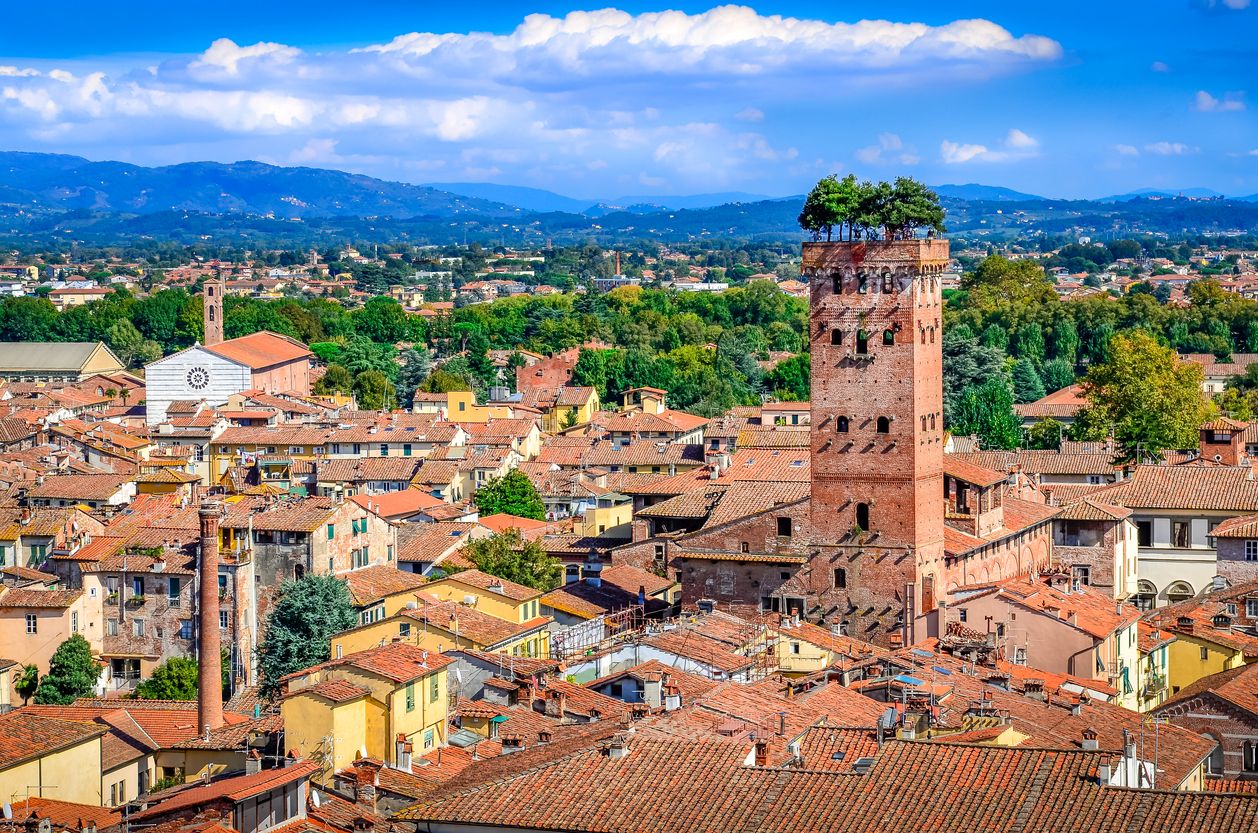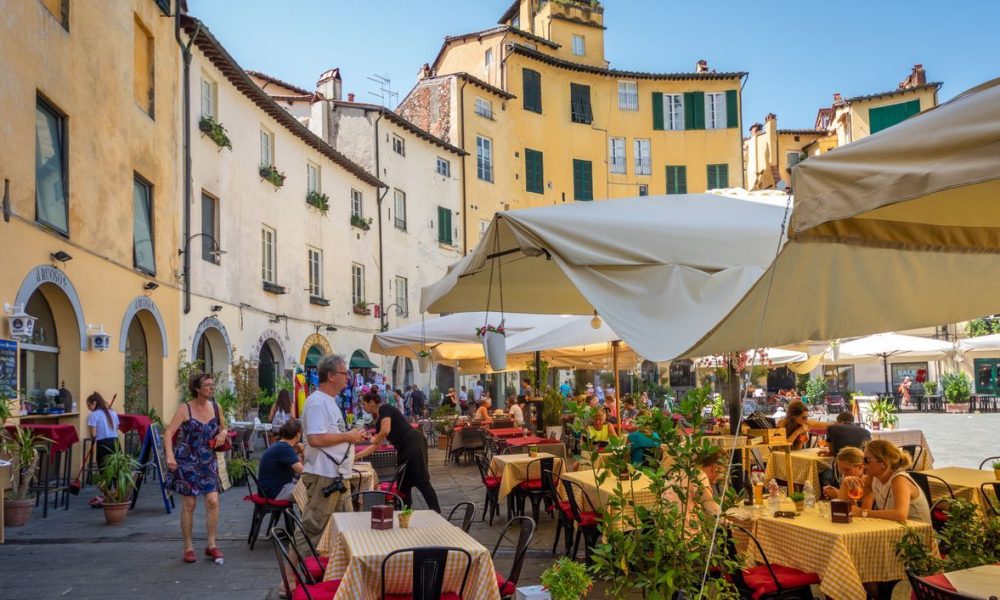
Piazza dell’Anfiteatro is one of the most distinctive and recognisable places within Lucca.
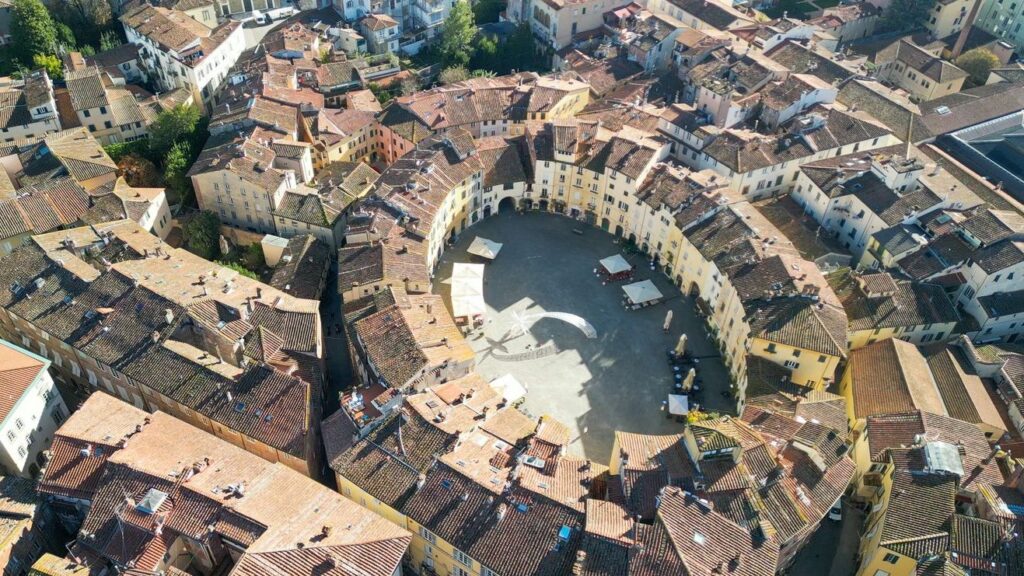
Different from other traditional Italian squares, which typically have straight edges and formal layouts, this piazza has a perfect oval shape that immediately sets it apart.
It was built on the remains of a Roman amphitheatre, and clearly shows how Lucca has evolved over nearly two thousand years while preserving its ancient foundations.
This guide explores the origins of Piazza dell’Anfiteatro, its Roman history, unique architecture, what to see nearby, and how to plan your visit.
Whether you are staying in the historic centre or visiting for the day, Piazza dell’Anfiteatro Lucca is a place worth exploring.
What is the Piazza dell’Anfiteatro in Lucca?
Located in the heart of Lucca’s historic centre, Piazza dell’Anfiteatro is located slightly away from the city’s main axis. You often stumble upon the piazza unexpectedly, passing through a narrow street before the space suddenly opens into an oval square.
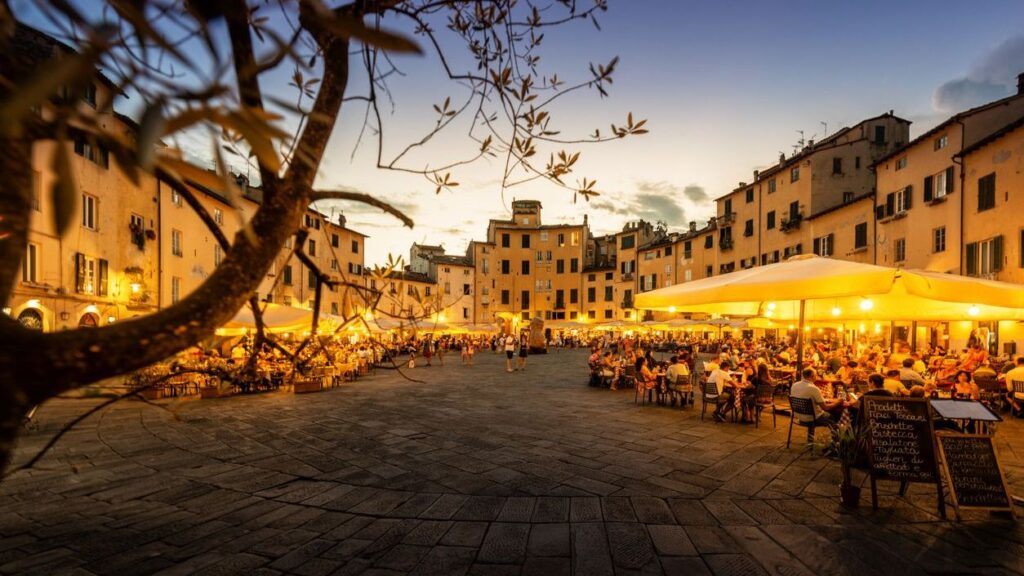
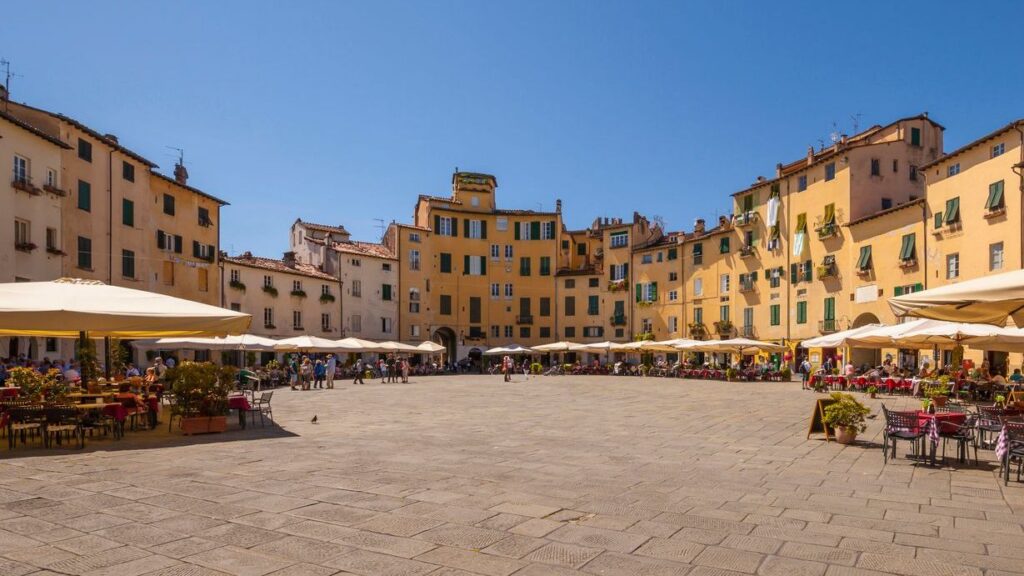
Today, Lucca Piazza dell’Anfiteatro is a lively square filled with cafés, restaurants, and small shops. Although it’s very popular, it remains a functional residential area, with apartments built directly into the ancient structure. The piazza is pedestrian-only and free to enter at all times. This makes it an easy stop during any walk through Lucca.
Important facts about Piazaa dell’Anfiteatro
Location: Centro Storico di Lucca (historical centre of Lucca)
Origin: Roman amphitheatre (1st–2nd century AD)
Access: Open 24/7, free entry
Current use: Public square with cafés, residences, and shops
History of the Roman amphitheatre
The origins of Piazza dell’Anfiteatro Lucca date back to Roman times. Lucca was known as Luca back then, and was an important settlement along the Via Cassia. The amphitheatre was built between the late 1st and early 2nd century AD, outside the original Roman city walls, as was customary for such buildings.
Archaeological studies estimate that the amphitheatre could hold up to 10,000 spectators, a significant number considering the size of Roman Lucca. It was used for gladiatorial contests and public spectacles until the decline of the Roman Empire.
During the Middle Ages, the abandoned structure was gradually repurposed. Stone from the amphitheatre was reused elsewhere in the city, while houses, warehouses, and workshops were built directly on top of the remaining walls. By the 12th century, the arena had become a densely inhabited neighbourhood, known as the Parlascio.
In the early 19th century, under the rule of Maria Luisa of Bourbon, the area was cleared and reorganised, giving the square its current appearance while preserving the original Roman footprint. This careful transformation is what makes Piazza dell Anfiteatro one of the clearest examples in Italy of Roman architecture shaping medieval and modern urban life.
The unique oval shape and architecture
What makes Piazza dell’Anfiteatro instantly recognisable is its perfectly elliptical shape. Unlike other piazzas in Tuscany, there are no straight sides here. Every building follows the curve of the ancient amphitheatre walls beneath.
Architectural details to notice
- Continuous curved façades reflecting the Roman foundations
- Uniform height of buildings, creating a harmonious skyline
- Windows and shutters aligned along the oval perimeter
- A slightly raised central area, marking the former arena floor
Finding the four entrance gates
The piazza has four entrance arches, found roughly at the cardinal points, following the original access routes of the Roman amphitheatre. Each gate leads into the square through a narrow passageway.
Tips for locating the entrances
- The most commonly used entrance is from Via Fillungo, Lucca’s main shopping street
- Look for arched passageways rather than open streets
- Walk around the exterior of the piazza to see how buildings sit on the Roman walls
Must-do checklist
- Walk the full perimeter outside the piazza
- Enter through at least two different gates
- Look closely at the stonework to spot Roman masonry embedded in later buildings
What to see and do nearby in Lucca
One of the advantages of visiting Piazza dell’Anfiteatro is its proximity to many of Lucca’s most important landmarks, all within a short walk.
Just a few minutes away, Guinigi Tower stands out for its unique rooftop oak trees and offers panoramic views over the city. A short walk in the opposite direction leads to San Michele in Foro, a Romanesque church built on the site of Lucca’s ancient Roman forum.
Continuing through the historic centre, you will arrive at Lucca Cathedral, famous for housing the revered Volto Santo crucifix. Meanwhile, if you enjoy art and architecture, it’s worth visiting Palazzo Pfanner, which is known for its elegant Baroque gardens.
Not far away, Piazza San Frediano is close to the Basilica of San Frediano, and finally, the Lucca City Walls are a must-see when visiting Lucca.
Things to do around the piazza
- Enjoy an espresso or an aperitivo (typically €4–€8)
- Visit local artisan shops selling ceramics and Tuscan food products
- Explore quieter residential streets just beyond the main square
Plan your visit to Piazza dell’Anfiteatro
Planning your visit ahead of time can help you organise your itinerary and enjoy Lucca to its fullest.
Best times to visit
- Early morning for photography and quieter walks
- Late afternoon or evening for atmosphere and dining
Seasonal considerations
- Summer temperatures often reach 30–33°C, especially in July and August
- Spring and autumn offer milder weather and fewer crowds
- Winter is quieter and ideal for relaxed exploration
Practical tips
- Wear comfortable shoes due to cobblestone streets
- Avoid peak hours (11:00–16:00) in high season
- Combine your visit with a walking route through Lucca’s historic centre
Stay near Piazza dell’Anfiteatro
Staying within the historic centre allows you to experience Lucca Piazza dell’Anfiteatro early in the morning and late in the evening, when the square feels most authentic.
Lucca Apartments and Villas offers a range of apartments and villas in central locations, ideal for exploring Lucca on foot while enjoying the comfort of a private stay.
Choosing accommodation nearby means cafés, churches, museums, and the city walls are all just minutes away, allowing you to experience Lucca at a slower, more local pace.