Lucca has six gates in its Renaissance walls, and most people head straight for Porta San Pietro or Porta Santa Maria.
Porta Sant’Anna tends to get overlooked, which is actually part of its appeal. This is the gate on the western side of the city, the one locals use habitually.
This guide covers the gate’s real history, what you’ll find around, and where to take the best photos.
The gate of Porta Sant’Anna
The gate’s official name is Porta Vittorio Emanuele, but nobody in Lucca calls it that. Locals know it as Porta Sant’Anna, after the Sant’Anna church that’s located just outside the walls nearby.
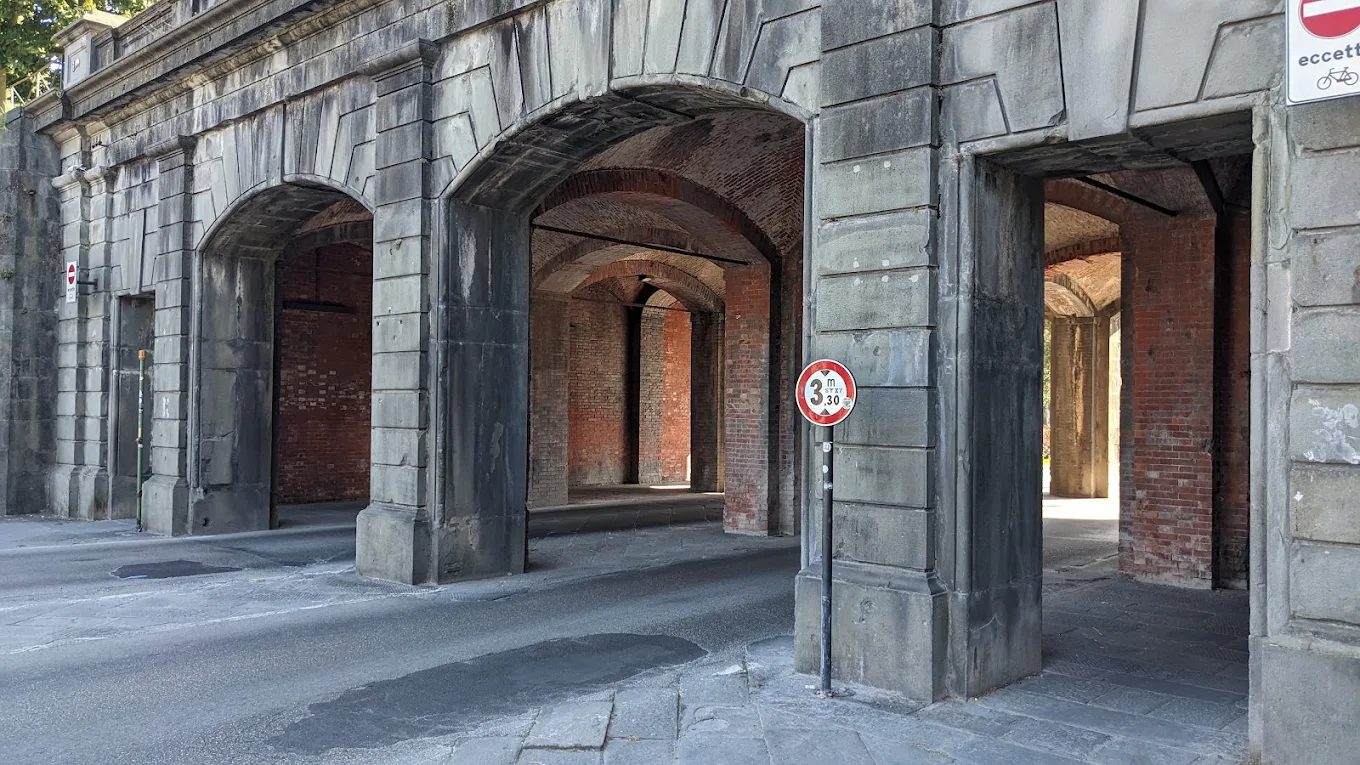
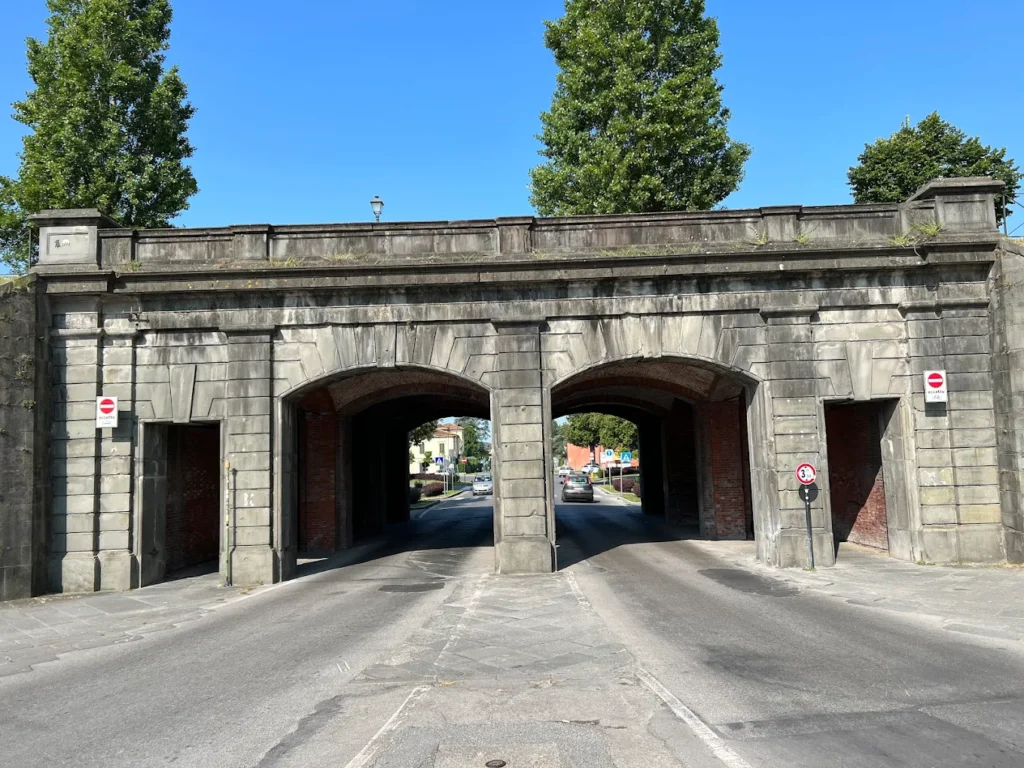
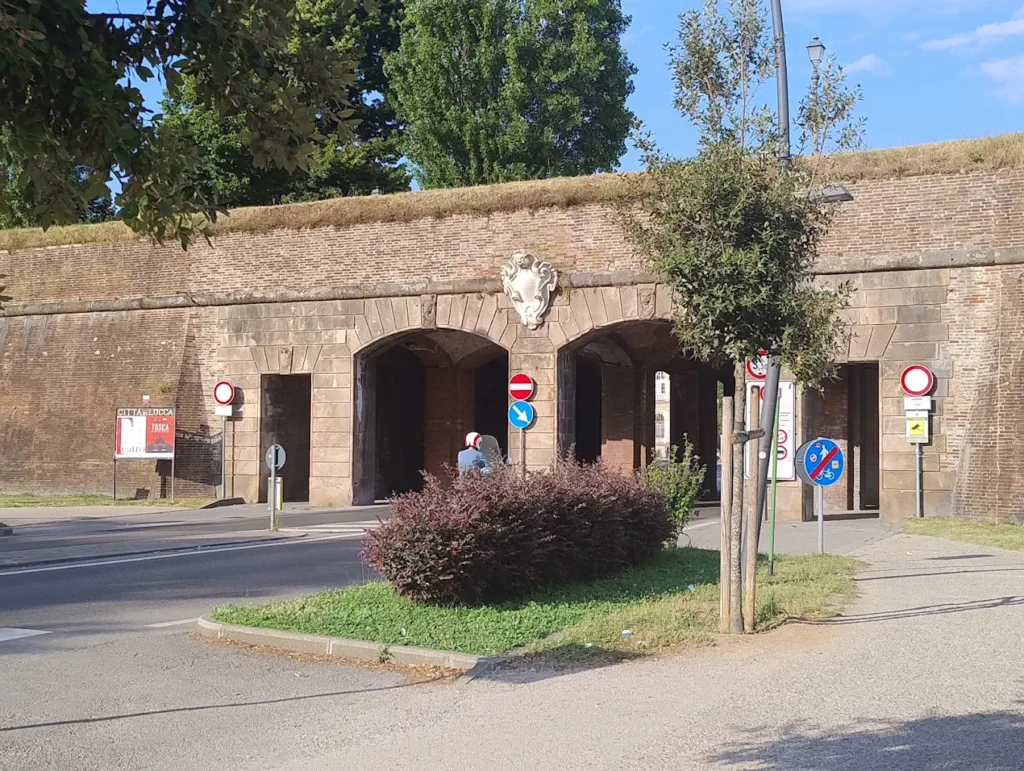
Porta Sant’Anna has four arched openings: two wider central arches for vehicle traffic and two narrower pedestrian passages on either side.
There’s a marble coat of arms of Lucca positioned between the two vehicle arches. That’s it. No towers, no grand relief sculptures, no elaborate stonework.
If you’re planning to discover the other gates of Lucca, note that each one is quite different in character. Porta San Pietro (1565/66) is an ornate Renaissance stone; Porta Santa Maria (1592) has a marble Madonna above its arch; Porta San Donato (1629) has elegant marble detailing. Porta Sant’Anna belongs to a different era entirely, and its simplicity is exactly what makes it stand out by contrast.
History of the Porta Sant’Anna gate in Lucca
Porta Sant’Anna Lucca was opened in 1910.
The gate couldn’t be taller than the wall’s parapet, because any superstructure would have blocked the Baluardo San Donato. So the design stayed simple.
Between 1911 and 1938, the Lucca-Ponte San Pietro-Maggiano tram line ran through Porta Sant’Anna. The tram line is now gone.
How to reach Porta Sant’Anna from the Vatican
A quick note on terminology…if you’ve searched for “Porta Sant’Anna Vatican,” you may have encountered results for two different places.
There is indeed a Porta Sant’Anna in Vatican City in Rome. This is the main working entrance to the Vatican on Via di Porta Angelica, guarded by the Swiss Guard. That’s a completely separate gate. Not to be confused with the gate of Porta Sant’Anna Lucca, which is one of the six gates in Lucca’s Renaissance city walls in Tuscany.
If you’re travelling to Lucca from Rome (including from the Vatican area), the most practical route is by train. Rome Termini to Lucca takes roughly 3 hours with a change at Florence Santa Maria Novella.
Exploring the surroundings of Porta Sant’Anna in Lucca
The area around Porta Sant’Anna Lucca is worth exploring. Here is what you’ll find nearby:
Baluardo San Donato is one of the eleven bastions built into the Renaissance walls. It sits directly adjacent to the gate.
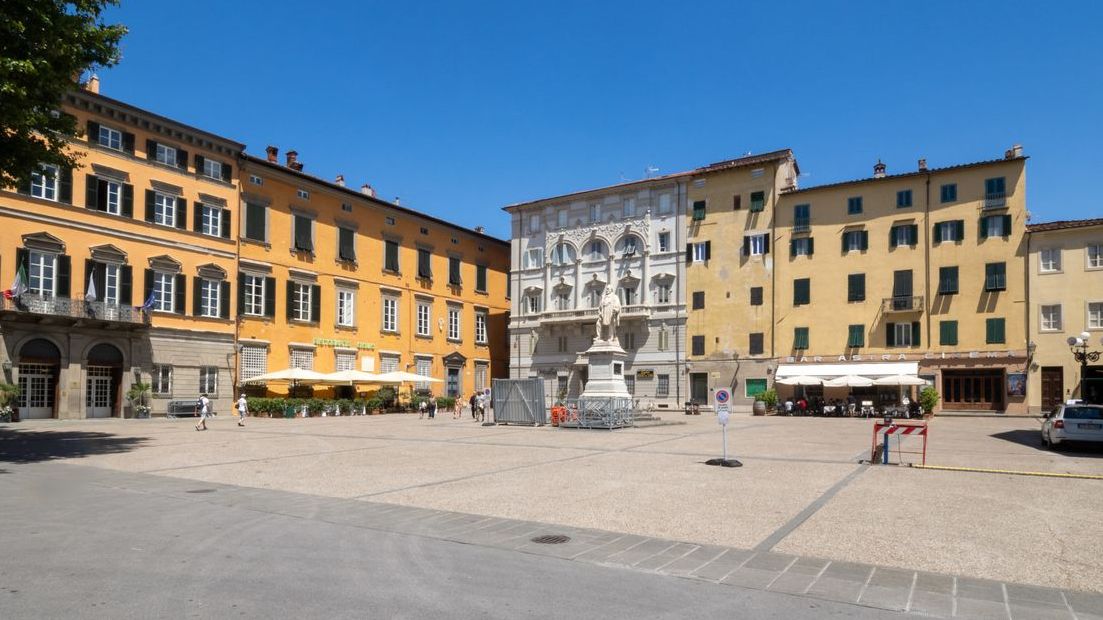
Via Vittorio Emanuele runs east from the gate into the city centre. Walk 10 minutes along it, and you’ll reach Piazza San Michele and the city centre proper. The street has a good mix of local shops and bars.
The Sant’Anna church that gives the gate its name is outside the walls, a short walk from the gate on the Via Sarzanese side.
From Porta Sant’Anna, you can access the Passeggiata delle Mura Urbane directly. This is the tree-lined walkway along the top of the walls, a 4.2-kilometre circuit that you can walk in about 1 to 1.5 hours or cycle in 20 to 30 minutes.
Bike hire is available near several gates. The walls are free to access at all times. If you want to explore Lucca’s other landmarks once you’re inside, the Roman Amphitheatre, Torre delle Ore and Basilica di San Frediano are all within 15 minutes on foot from the gate.
Tips for visiting Porta Sant’Anna
There’s no entry fee and no ticket required. The gate is open for pedestrians and cyclists at all times; vehicle access follows normal city traffic hours.
- Getting there on foot from the station: Turn left out of Lucca Centrale, walk west along Viale Cavour for approximately 800 metres. The gate is directly in front of you.
- Parking nearby: Paid surface parking is available on Viale Vittorio Emanuele outside the walls. Don’t drive inside the ZTL zone without a permit.
- Accessing the walls: Steps up to the Passeggiata delle Mura Urbane are from Baluardo San Donato, immediately adjacent to the gate.
- Bike hire: You can rent bicycles at several points around the walls. A lap of the 4.2-kilometre circuit takes 20 to 30 minutes by bike, 60 to 90 minutes on foot.
Best photo spots around the gate
- Exterior facade from Via Sarzanese: Stand roughly 20 to 30 metres back on Via Sarzanese for a straight-on shot of all four arches and the Lucca coat of arms above the central vehicle passages. Morning light works best here.
- Through the arch from inside: Standing inside the gate and shooting outward towards Via Sarzanese gives you the arch as a natural frame around the street beyond. Works at any time of day.
- Top of Baluardo San Donato: This is the best elevated viewpoint near the gate. From up here, you can photograph the gate below, the roofline of the old city, and on clear days, the Apuan Alps to the north. Access is via the steps next to the gate.
- Via Vittorio Emanuele looking east: Stand just inside the gate and shoot along Via Vittorio Emanuele towards the city centre. The street narrows slightly as it heads east and the perspective compresses nicely, particularly in late afternoon light.
- Wall detail shots: The sandstone ashlar cladding of the gate and the brick vaulting of the pedestrian passages both photograph well as architectural detail shots. The contrast between the pale stone exterior and the warm brick interior is worth capturing.
If you’re planning to photograph multiple gates in one day, Porta Sant’Anna combines well with Porta San Donato, just a few hundred metres to the north along the walls.
The contrast between the 1629 Renaissance gate and the 1910 one is striking when you see them back to back.
Plan your visit to Porta Sant’Anna and stay in Lucca
Porta Sant’Anna Lucca is the kind of place you find yourself returning to, not because it’s spectacular, but because it’s genuinely part of how the city works.
To make the most of Lucca, you want to be based inside or immediately outside the walls, within easy reach of the gates, the streets, and the piazzas.
Lucca Apartments and Villas offers a carefully selected range of holiday apartments in Tuscany and villas in Tuscany, including properties in and around Lucca.
Whether you’re travelling as a couple, with family, or as a group, your ideal accommodation awaits you!