Porta Santa Maria is the grand northern gate and is the one most people pass under when they arrive from the train station side of town.
This article walks you through the history of Porta Santa Maria Lucca, the architecture and details worth spotting, what sits nearby, and how to reach the historic centre.
What is Porta Santa Maria?
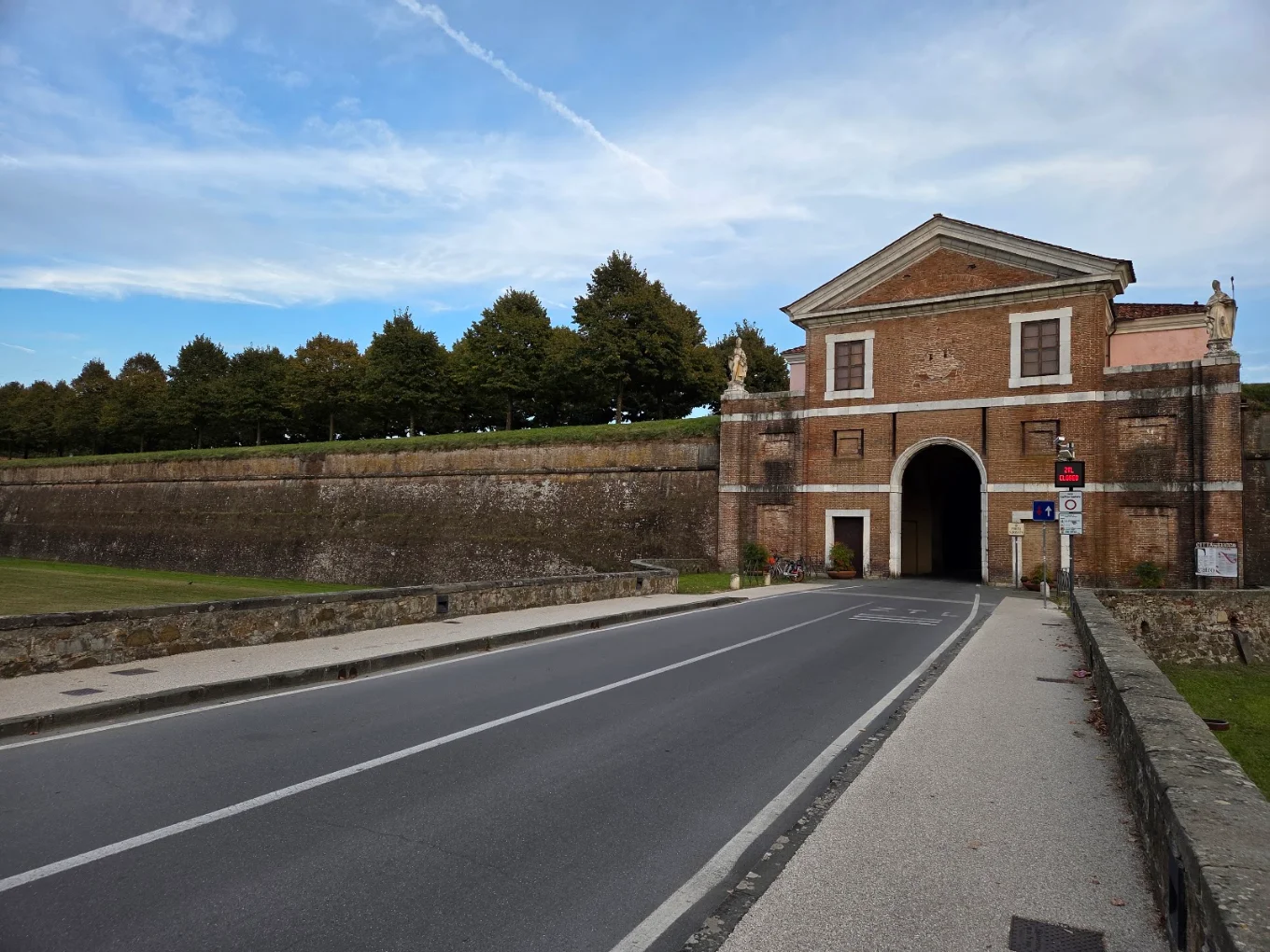
Porta Santa Maria is the northern gate in Lucca’s famous Renaissance walls, dedicated to the Virgin Mary.
It is one of only three original 16th-century gates, alongside Porta San Pietro to the south and Porta San Donato to the west. The gate stands between the San Martino bastion and the San Frediano platform, and it has long been one of the main and most convenient entrances into the city.
- Location: Northern side of Lucca’s walls, near the Foro Boario car park
- Built: Between 1549 and 1592
- Designer: Ginese Bresciani, with works directed by Michelangelo Gabrielli
- Openings: Three (one central pedestrian arch, two for traffic)
- Cost to walk the walls: Free
- Walls total length: Just over 4 km
The history of Porta Santa Maria in Lucca
The Republic of Lucca decreed the new fortifications in 1504, worried about the expanding Medici family in nearby Florence.
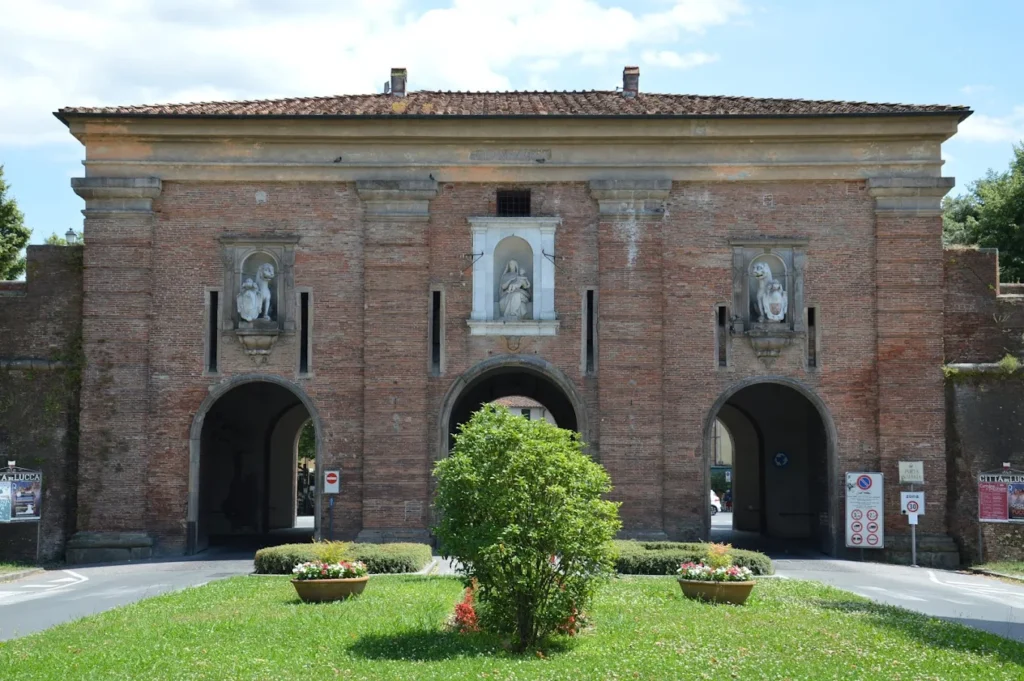
Porta Santa Maria itself went up between 1549 and 1592. Bresciani drew the plans, and Michelangelo Gabrielli oversaw the building work. The marble statue of the Madonna and Child at its centre was carved by Giuseppe da Genova in 1595.
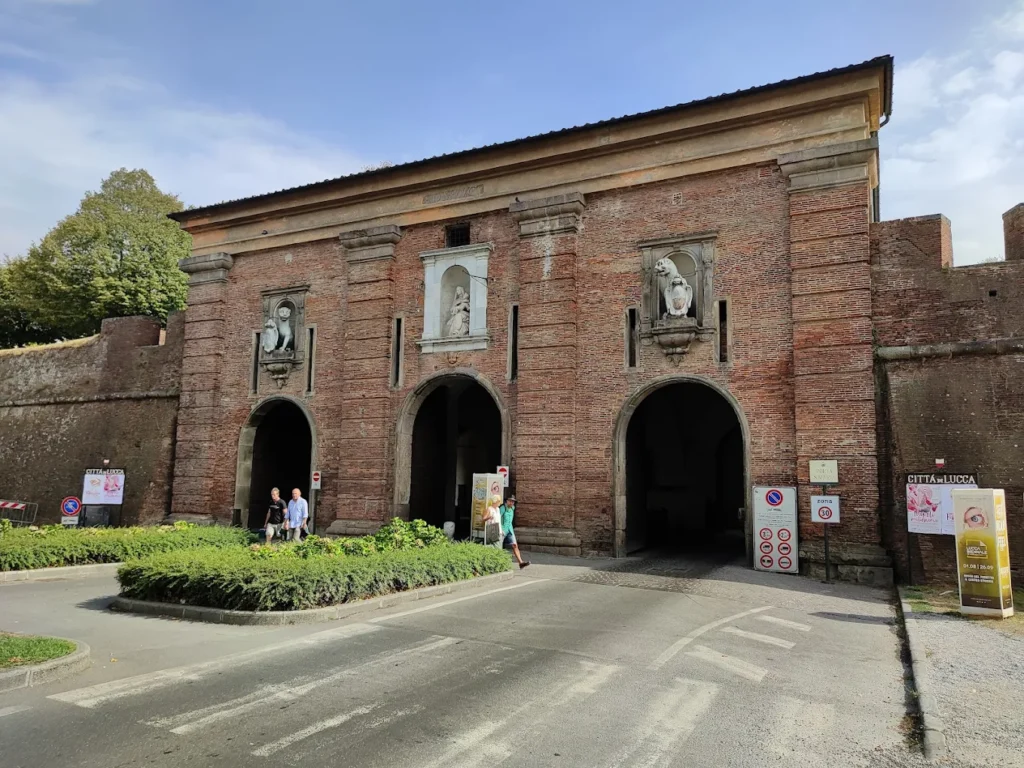
The gate originally had just a single fortified arch. However, the two side openings were added later to ease the flow of traffic, and as a result, it now has three.
By the early 19th century, the walls had lost their defensive purpose, and Duchess Maria Luisa of Bourbon handed them to her court architect Lorenzo Nottolini. He turned the ramparts into the tree-lined public promenade you walk today. There was even a tram line running through the gate between the 1880s and 1932.
The architecture and details of the gate
Porta Santa Maria is built from red brick in a simple style. Four giant-order pilasters frame the façade, and three niches sit above the three portals.
Details worth noting include:
- The Madonna and Child: The central marble statue, carved by Giuseppe da Genova in 1595, gives the gate its name.
- The panthers: Two limestone panthers flank the gate, each holding the coats of arms of the Commune and the Republic of Lucca. They replaced an earlier pair of lions.
- The Annunciation frescoes: Under the central arch, two frescoes show the Annunciation, with the Archangel Gabriel on one side and the Madonna on the other.
- The “Libertas” relief: On the inner façade, a marble bas-relief of St Peter sits above the city’s ancient motto, “Libertas”.
What to see near Porta Santa Maria
When you arrive through Porta Santa Maria Lucca drops you near some of the city’s best sights within Lucca, all within an easy walking distance.
- Piazza dell’Anfiteatro: The oval square built on the ruins of a Roman amphitheatre, ringed with cafés, is a few minutes south of the gate.
- Basilica di San Frediano: The 6th-century basilica with its golden mosaic façade and the body of Santa Zita sits very close by.
- Via Fillungo: Lucca’s main shopping street threads down from this part of town towards the centre.
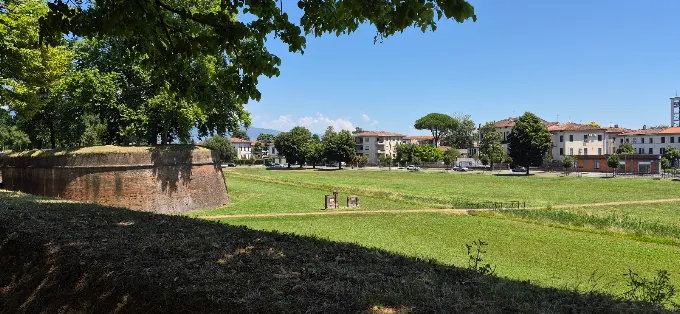
- The walls themselves: Step straight up onto the ramparts and walk in either direction under the plane trees.
In our opinion, this part of Lucca also makes a good base for exploring further into the city. The grand gardens and hedge theatre of Villa Reale di Marlia are about 8 km out, and the elegant square of Piazza Napoleone with its Palazzo Ducale and opera house is a short walk across the centre.
How to get there and access the historic centre
Reaching Porta Santa Maria is easy.
- On foot from the centre: From Piazza dell’Anfiteatro, head north for a few minutes and you reach the gate.
- From the train station: Lucca’s station sits just outside the southern walls. Cross the centre on foot, roughly 15 to 20 minutes, or loop around the outside.
- By car: There is paid parking near the gate on the blue-line bays and at the nearby Foro Boario area. The historic centre is largely closed to traffic, so park outside and walk in.
- Accessing the ramparts: Ramps and steps lead up to the wall walk close to the gate. The path along the top is flat, wide, and easy for pushchairs and bikes.
Tip: The wall walk from here gives some of the best views in the city, taking in the Pisan mountains to the south, the Apuan Alps to the west, and the Garfagnana hills to the north.
Tips for your visit to Lucca
Must-do checklist:
- Look up at the Madonna and Child and the two panthers holding the city’s arms
- Step under the central arch to find the Annunciation frescoes
- Spot the “Libertas” relief on the inner face of the gate
- Climb onto the ramparts and walk a full section under the trees
- Carry on to the Basilica di San Frediano and Piazza dell’Anfiteatro nearby
A few extra pointers for visiting Lucca city centre
Come early in the morning or near dusk for quieter streets and softer light. Bring comfortable shoes, since the centre is all cobbles.
If you plan to cycle the walls, rental shops near the gates hire bikes by the hour. Additionally, if you’re around in summer, the warm Tuscan months, with their long evenings and local festivals, make it a fine time to wander the ramparts after sunset.
Book your visit to Lucca today
Porta Santa Maria is a 16th-century gateway watched over by a marble Madonna and two stone panthers, the threshold to a city that has guarded its centre for centuries and never once had to fight for it.
The best way to enjoy Porta Santa Maria Lucca is to stay close enough to step out at first light or after dark, when the crowds thin and the walls feel like your own.
At Lucca Apartments and Villas, we offer carefully chosen apartments and villas inside and around the historic centre. Book your perfect base for exploring the gate, the walls, and everything beyond!